
Greene County Release Records
A Greene County release means the sheriff no longer holds the person under the same jail commitment. It may be a community release after bond, dismissal, time served, or a local sentence. It may also be a transfer. The Greene County Detention Center holds pretrial detainees, people serving local terms of up to twelve months, and some people awaiting Georgia Department of Corrections bed space after a more serious sentence. A transfer from the county jail to GDC ends the county stay but does not end custody.
The agency and record must match the event. The Greene County Sheriff's Office keeps the jail commitment and discharge record. Magistrate Court can explain an early bond decision. Superior Court records can show a felony disposition, sentence, revocation, or transfer order. GDC records track state custody. The State Board of Pardons and Paroles and Department of Community Supervision address parole and felony supervision after state release.
- Discharge
- The documented end of a particular jail or prison commitment.
- Time served
- Release after the ordered custody term and credited time are complete.
- Parole
- Conditional community release from a prison sentence under state authority.
- Probation
- A court-ordered community sentence, sometimes following a jail or prison term.
- Detainer
- A request or legal basis for another agency to take or keep custody.
Greene County Release Types
The discharge reason controls where a Greene County released inmate appears next. A bond release points back to the bond papers and court docket. Sentence completion points to the sentencing order and jail calculation. A state transfer points to GDC once intake is complete. The term “released” should never be read as “free of all custody” until the receiving-agency field and court record have been checked.
| Release path | Meaning | Best next record |
|---|---|---|
| Cash, property, or surety bond | The person leaves local custody while the case continues. | Jail discharge, bond papers, Magistrate or trial-court docket |
| Time served | The local custody term is complete. | Sentencing order and sheriff discharge record |
| Dismissal or court order | A judge or prosecutor action changes the custody basis. | Court disposition and discharge order |
| Probation | The person serves a court-ordered term in the community. | Court sentence and DCS when felony supervision applies |
| Parole | A state prisoner leaves confinement under conditions. | Parolee Database and DCS |
| Transfer | Another county, GDC, federal, or immigration agency receives the person. | Transfer record and receiving-agency locator |
Death in custody may also close a jail commitment, but it is not a community release. The official record must be used rather than an inference from a vanished roster entry.
Greene County Discharge Record Fields
Georgia law requires more than a bare name list. Under O.C.G.A. 42-4-7, the sheriff keeps a record of each person committed to the county jail. The required facts tie the custody start to the legal process and the discharge to an order. That record can still exist when no public roster or recent-release page is online.
| Field | What it establishes |
|---|---|
| Name, age, sex, race | Identity details recorded at commitment |
| Commitment process | The warrant, order, or other basis for custody |
| Issuing court | The court tied to the commitment |
| Charged crime | The allegation recorded by the jail, not a final finding |
| Date committed | When the jail stay began |
| Day of discharge | When that county commitment ended |
| Discharge order | The legal authority or reason for leaving |
| Court issuing discharge | The court responsible for the release order |
Ask for related bond and transfer fields when relevant. A booking number helps join records, while a receiving-agency notation can distinguish a ride home from a move to state custody. Charges shown at booking may differ from the final court outcome.
Request Greene County Release Records
No official public Greene County recent-release roster was confirmed in the research. A focused request to the Greene County Sheriff's Office is therefore the most direct route to a formal local discharge record. The county directory lists the office at 1180 C Weldon Smith Drive, Suite 130, Greensboro, GA 30642, and 706-453-3351. The detention center itself is at 1201 South Industrial Boulevard in Greensboro.
- Identify the person by full name and date of birth if known. Add an approximate booking or release range.
- Ask for the jail booking and discharge record, including the date, discharge reason or order, issuing court, bond details, and receiving agency.
- State that the request is to verify custody and release information. Ask for the booking photograph only when it is needed for lawful identification or record verification.
- Submit the request to the sheriff and keep the response. If the person entered GDC, use the GDC Open Records Request for state records.
- Pair the jail response with the proper court record when the reason for release matters.
O.C.G.A. 50-18-71 sets a response standard of a reasonable time not exceeding three business days. If records cannot be produced then, the agency should provide timing and cost information. The statute does not require creation of a record that did not exist when requested.
Record restriction, often called expungement in everyday speech, can change the public visibility of some criminal history information. It does not justify guessing that a missing result proves no arrest or discharge occurred. Agency and court access follows Georgia law.
Greene County Bond Release Costs
Greene County's Detention Center Public Information Sheet gives unusually detailed bond-out rules. For a cash bond, it states that the bond amount is due with a Peace Officers Annuity Fund fee of $20 for an in-county bond or $38 for an out-of-county bond. Cash, traveler's check, or cashier's check may be used. These amounts concern the documented bond process, not a fee for obtaining a public record.
Property bond has a different test. The sheet calls for improved real estate, normally in Greene County unless another jurisdiction approves it, with enough equity to cover the bond. All owners of record must sign, and the sheriff or a designee must approve the property bond. Professional bondsmen must also be sheriff-approved. A list is kept in the public lobby and booking area.
Find Greene County Released Inmates
Finding a named person requires a custody trail, not one universal database. Start local. Then follow the record to the state, court, federal, or immigration system only when the facts point there. A live jail roster, if one becomes available, would mainly show who remains in custody. It is not a durable archive of Greene County released inmates.
- Contact the Greene County Sheriff's Office for current status and the discharge entry. No official 24-hour, 72-hour, or current roster was found on reviewed county sources.
- Check the court tied to the release. Magistrate Court handles first appearances and bond hearings. Superior Court records can explain felony sentencing and transfer.
- Use GDC Offender Search when the person may have entered Georgia state custody.
- Use Georgia VINE for a named custody-status check or alert, while treating the sheriff or court record as confirmation.
- For a federal sentence, use BOP. For a reported immigration transfer, use ICE. Neither is a general Greene County release list.
- File a focused records request when online tools do not settle the question.
For a same-day feed question, the Greene County 24-Hour Releases page explains the local fallback in more depth. Absence from one search can reflect name variation, intake delay, transfer, record aging, or a system that never received the event.
Greene County GDC Release Search
GDC covers state inmates, not every person booked in the Greene County Detention Center. Search by name, GDC ID, case number, age, or other identifying details. A sentenced person held locally while waiting for GDC bed space may not appear until state intake posts. Once the state record exists, read status, location, sentence data, Maximum Release Date, and parole information in context.
| Search input | Use | Caution |
|---|---|---|
| Name | Broad starting point | Try legal spelling and confirm identity |
| GDC ID | Best match for a known state offender | Does not identify county-only custody |
| Case number | Connects a state record to a case | Confirm the correct court and person |
| Age and description | Narrows similar names | Do not rely on a photo alone |
The GDC Find an Offender page warns that public search data should be verified through written correspondence with Inmate Records and Information, PO Box 1529, Forsyth, GA 31029.
The official GDC search form shows the actual state lookup fields.
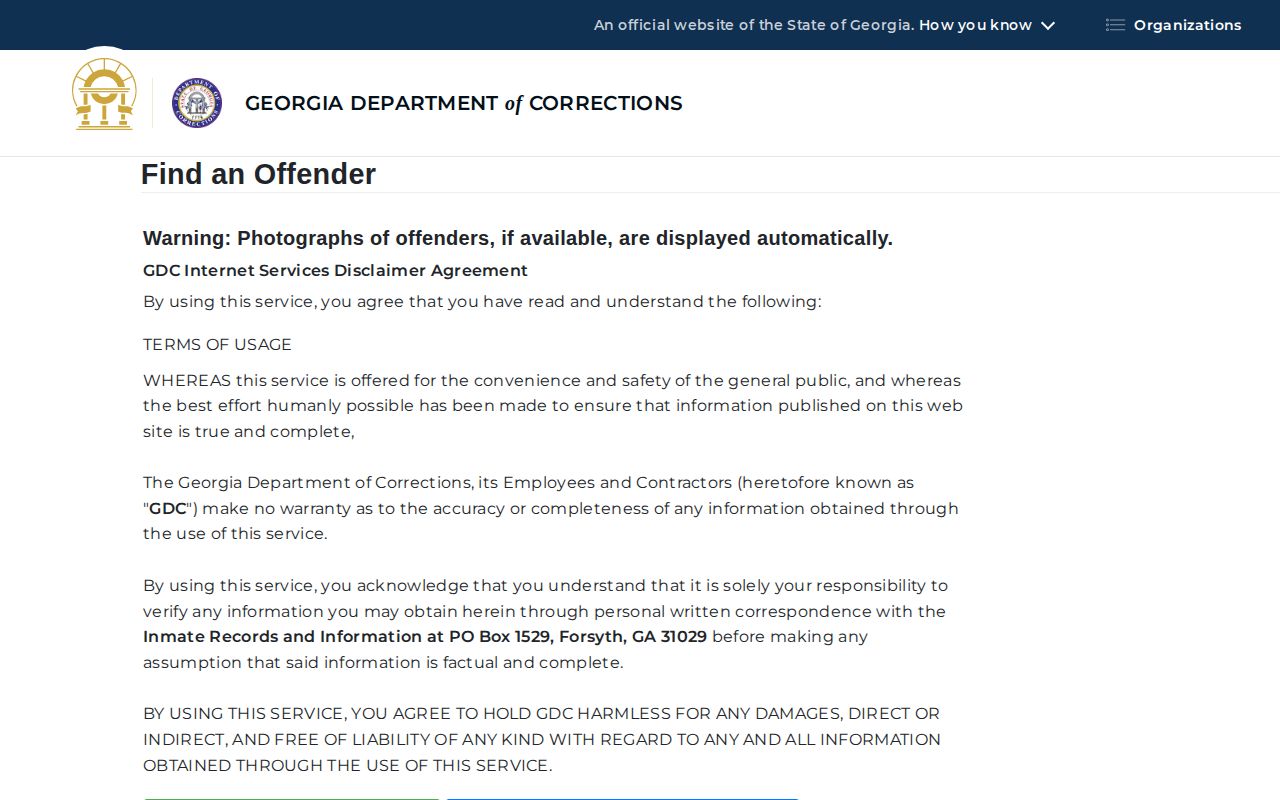
This state form is useful only when GDC has custody or a state record. County discharge remains with the sheriff.
Greene County Court Release Check
Greene County divides release explanations between courts. Magistrate Court handles first appearances, bond hearings, pre-warrant application hearings, and preliminary hearings. Its early order may explain why a person left within hours or days. The sheriff record supplies the actual day of discharge.
The Clerk of Superior Court manages Superior and Juvenile records. A felony file may show a plea, sentence, probation term, revocation, dismissal, or transfer order long after a jail roster entry disappears. The GSCCCA listing identifies the clerk's office at 113 N. Main Street, Suite 109, Greensboro, with phone 706-453-3340 and weekday hours from 8 a.m. to 5 p.m. Juvenile access is limited by the rules that apply to those records.
The Greene County courts directory shows the local court paths.
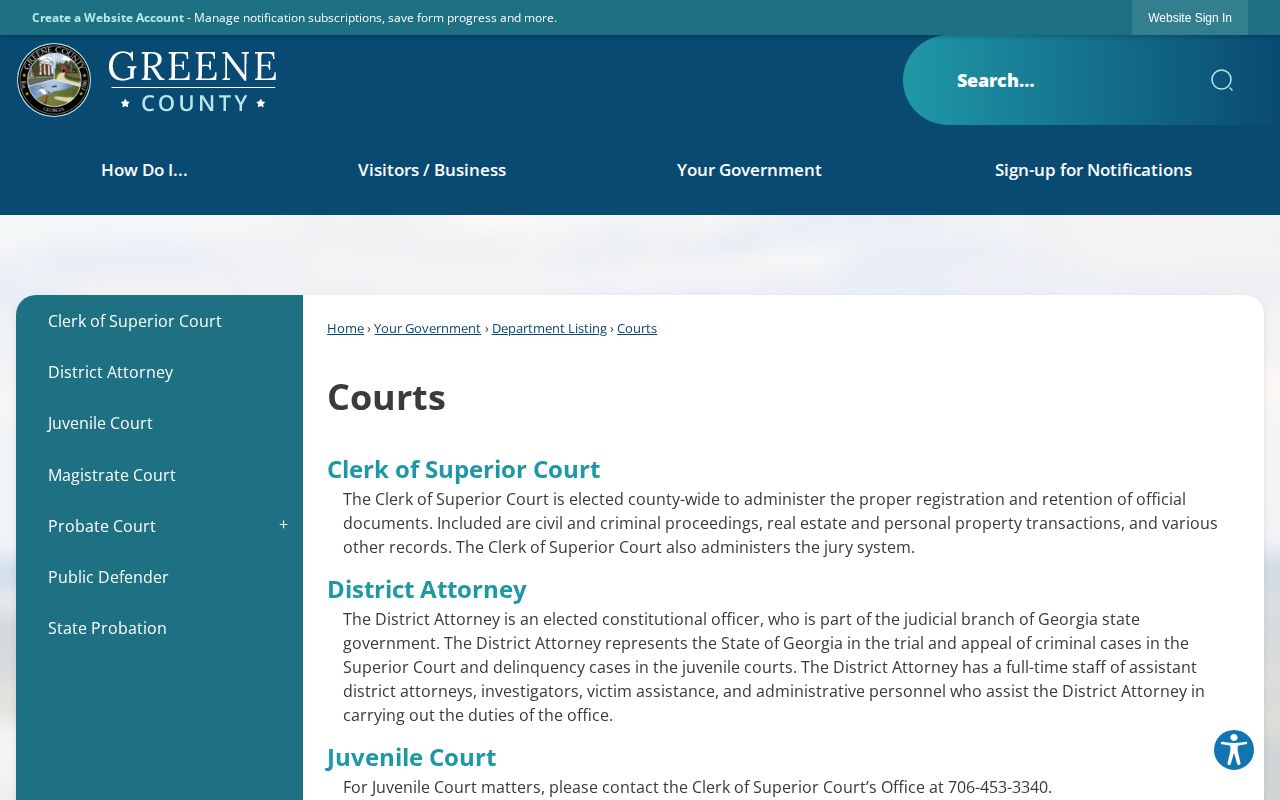
Use the court file to explain the legal result and the jail record to prove the custody exit.
Greene County Transfer Releases
The Greene County Detention Center's local role creates a key distinction. Its official detention page says the jail holds people sentenced for more serious crimes until GDC bed space is available. A sheriff record may therefore show release to GDC. That is an agency transfer, not a return to the community.
After transfer, allow for intake posting and search GDC. If the record instead identifies another county, a federal agency, or ICE, use that receiving system. BOP says a past release date with no listed facility means the person is no longer in BOP custody, but the person could still be supervised or held elsewhere. ICE's locator covers current ICE custody and certain CBP custody, not old Greene County jail discharges.
| Status question | Best source |
|---|---|
| Still in Greene County jail? | Sheriff or detention center |
| Discharged from county jail? | Sheriff discharge record |
| Transferred to state prison? | Transfer record, then GDC |
| Released on parole? | Parolee Database and DCS |
| Federal release? | BOP Inmate Locator |
| Immigration transfer? | ICE locator after the transfer is reported |
Greene County Release Notifications
Georgia VINE can check a specific person and register custody-change alerts. Results depend on agency participation and data feeds. A released result may say released, not in custody, or show no current status. A missing result does not prove the person was never booked. Confirm a local release with the Greene County sheriff and the relevant court.
The Board and GDC also describe V.I.P., a telephone system that can provide state location, parole status or eligibility, maximum or scheduled release information, and an indication that a person is not in custody. These tools notify or summarize. They do not replace the discharge order, explain a bond source, or resolve a detainer.
Post-release supervision is separate from custody. DCS consolidates felony parole and probation supervision by residence geography. Greene County is served through the Milledgeville field office, while the conviction and sentence record can remain in Greene County.
Greene County State Release Funds
A Greene County case that became a GDC sentence can end with a Georgia Release Card. GDC states that leftover money on a state inmate's account is moved to the card after release. The person activates it by calling 866-777-5729 and setting a PIN. This is a state-prison release process. It is not a Greene County jail property rule.
The distinction matters when helping someone after release. First confirm which agency completed the discharge. A county bond release calls for local paperwork and property procedures. A later state discharge may involve GDC records, parole conditions, DCS reporting, and the release card. Mixing those systems can send a person to the wrong office.
Greene County Release Facilities
Each Greene County release channel has its own file and purpose. The county jail and sheriff records office handle local custody. State, court, federal, immigration, notification, and registry systems answer narrower questions. The Georgia Sex Offender Registry applies only when a released person has a registrable offense. It is not a list of all released inmates.
- Greene County Detention Center / Greene County Jail
- Greene County Sheriff's Office
- Georgia Department of Corrections Find an Offender
- State Board of Pardons and Paroles / DCS
- Georgia VINE / VINELink
- Greene County Superior and Magistrate Courts
- BOP, ICE, and Georgia registry systems when their special jurisdiction applies
Verify Greene County Release Dates
A date shown by one office must be read as that office's event. The sheriff's day of discharge marks the end of Greene County jail custody. A court order date may come earlier. GDC intake can come later. A Tentative Parole Month is planning information, not a final release day, and a Maximum Release Date belongs to a state sentence calculation rather than a local bond case.
Start with the legal basis. Pretrial detainees often have no fixed release date because bond and court action control the result. A person serving a local sentence needs the sentencing order, jail credit, and sheriff calculation. A state prisoner may have an MRD, parole consideration, and changes tied to lawful credits or discipline. Do not apply a state formula to a county jail term.
When two dates conflict, request the source records instead of choosing the earliest result. The discharge record proves the county exit. The court order explains authority. A receiving-agency entry proves continued custody. Together, those records provide a defensible timeline for Greene County released inmates without treating a projected date as a completed release.
Greene County Release Record Limits
Public access has boundaries. Juvenile records may not be open in the same manner as adult files. Georgia record restriction can change the visibility of qualifying history. Booking photographs have separate disclosure limits, including O.C.G.A. 35-1-19 when a photo may be posted where removal requires payment. None of those limits turns an incomplete search into proof about the event.
Use the narrowest official source that answers the question. Ask the sheriff when county custody ended. Ask the court why. Ask GDC about state custody and the Board or DCS about parole and supervision. This division keeps Greene County release records accurate and avoids forcing every case into one online tool.