
Greene County Parole and Probation
Parole permits an eligible state prisoner to serve part of a sentence in the community under conditions set through the State Board of Pardons and Paroles. Probation comes from a court sentence. It may replace confinement or follow confinement as part of a split sentence. Georgia's Department of Community Supervision, or DCS, supervises both parolees and felony probationers by residence geography.
| Issue | Parole | Probation |
|---|---|---|
| Source | State Board decision after a prison sentence | Sentence or order from the court |
| Before release | Inmate TPM Lookup may show tentative timing | The sentencing order states the probation term |
| After release | Parolee Database and DCS records | Court record and DCS office |
| End point | Board or sentence discharge | Completion or court-approved change |
A Greene County jail release on bond is neither parole nor proof of probation. The Magistrate Court bond record or Superior Court file explains that event. Parole becomes relevant when a person served a Georgia state-prison sentence. The distinction guides every later search.
Verify Greene County Post-Release Supervision
Begin with the type of custody and sentence, not a guess based on where the person was arrested. A Greene County conviction can lead to local probation, state prison, parole, or a split sentence. Each creates a different record.
- Read the Greene County court disposition and sentencing order.
- For a person still in GDC custody, use the Board's Inmate TPM Lookup.
- For someone believed to be on parole, search the Parolee Database.
- Use DCS Find a Field Office based on the person's residence.
- Confirm uncertain status with the Board, DCS, or the issuing court.
The Board's Parolee Database is for people already on parole. The Inmate TPM Lookup is a prison-stage tool. A Tentative Parole Month is not a final decision and may be delayed or canceled. For the wider county, state, and federal custody paths, use the Greene County release-record guide.
Greene County DCS Field Office
Greene County is served through the DCS Milledgeville field office, not an office in Greensboro. DCS assigns supervision geographically by residence. Thus, the court file can remain in Greene County while the field officer works from Milledgeville. The listed coverage also includes Baldwin, Hancock, Jasper, Jones, Morgan, Putnam, Wilkinson, and the Ocmulgee Circuit.
2930 Heritage Place
Milledgeville, GA 31061
DCS office directory
The DCS field-office directory is shown below. The live directory should be checked before a visit because assignments and contact details can change.
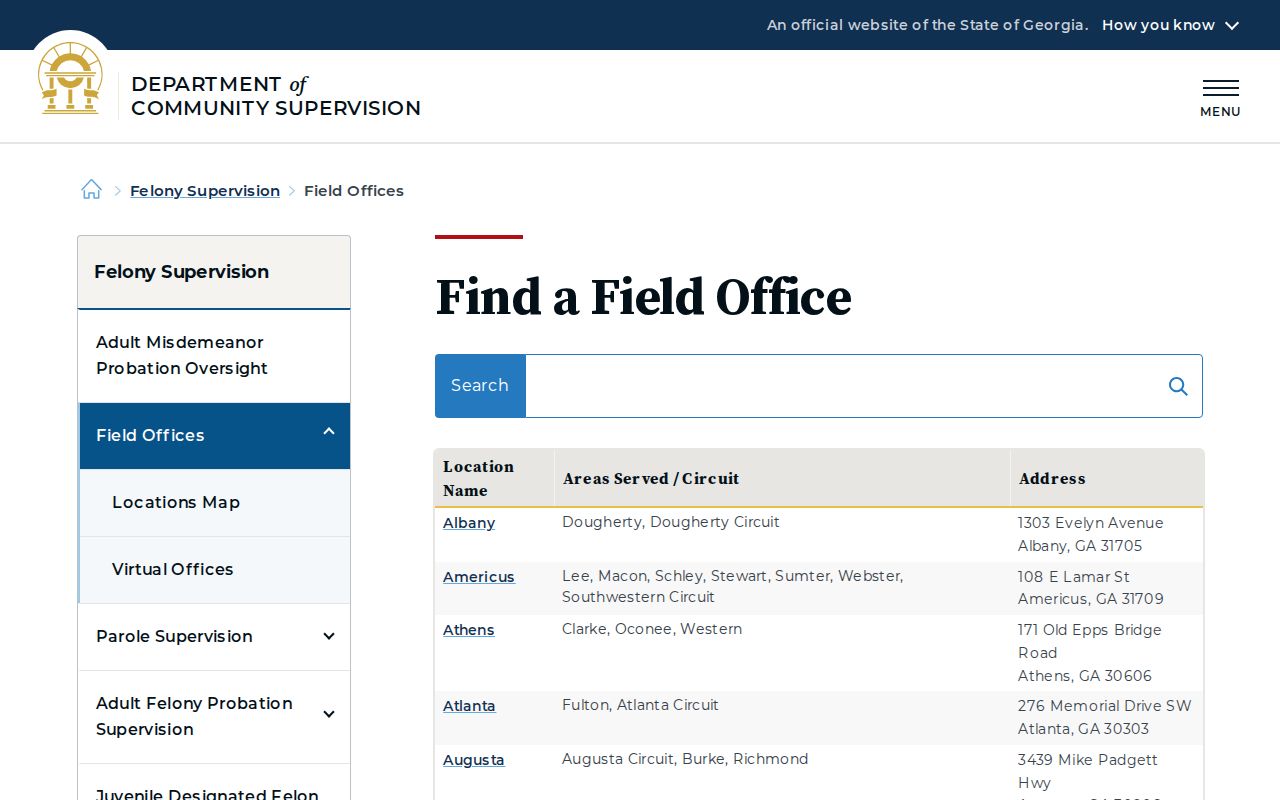
This office listing confirms the local route from a Greene County residence to state felony supervision.
Greene County Supervision Status Changes
Conditions are enforceable rules attached to release or sentence. They can include reporting, approved residence, travel limits, program participation, financial duties, or conduct rules. The signed order or parole certificate controls. A general web summary cannot show the exact terms for one person.
A missed report does not by itself establish the final legal outcome. DCS may investigate, the court or Board may issue process, and a warrant or revocation can follow. “Absconder” describes a reported supervision status, not a new sentence. Verify it with DCS, the Board, and the court record. VINELink may report a later custody change, but it does not explain the violation decision.
Board public meetings are also easy to misread. Monthly notices cover operations, policy, and presentations. The Board says ordinary parole cases are voted electronically each day and are not decided in those public monthly meetings. Use the TPM or parolee tools for a person, not a meeting notice.
How Greene County Supervision Ends
Supervision ends through an official discharge, sentence completion, or another authorized order. Leaving custody is not the same as discharge. A parolee may be outside prison and still serve the sentence under supervision. A probationer may complete confinement but still owe years on a court term.
For probation, the Greene County court file is the best source for the original sentence, later modification, revocation, and completion. For parole, use the Board and DCS. Keep copies of formal discharge papers. A person who simply stops appearing in an online search should not be assumed discharged, since public tools can change or omit older records.
Greene County State Release Funds
A Greene County detainee transferred into GDC may later leave state custody with funds handled through Georgia's release-card process. GDC says money left on a state inmate account is placed on a Georgia Release Card after release. The card can be activated at 866-777-5729 by setting a PIN.
This is a state-prison process. It is not a Greene County jail property rule and should not be used to infer where a county detainee went. Confirm a transfer through GDC first. If state release is established, the release-card channel can help explain how remaining account funds are returned while DCS handles any continuing supervision.
Greene County Parole Timing Records
The State Board provides two tools for two stages. Inmate TPM Lookup serves a person who remains in prison and has reached the parole process. The Parolee Database serves a person who has already been released on parole. Mixing them can produce a false impression that no record exists.
A TPM is a planned year and month, not a release order. Good conduct and required programs can affect final review. The Board may postpone or cancel it. For most parole-eligible sentences, the Board says review becomes available after one-third of the prison term, but statutory exclusions and Board discretion remain. Life-sentence cases use a different grant-or-deny framework.
When the Parolee Database identifies the person, use DCS to confirm the field-office route. The Board decides parole matters, while DCS performs community supervision. A record that says parole therefore points to both agencies for different questions.
Greene County Probation Court Records
Probation starts with the sentencing court. The order can show whether the sentence is wholly probated or split between confinement and community supervision. It may also show the length of the term and special conditions. DCS explains that felony probation is part of its consolidated supervision work.
The Greene County Superior Court Clerk manages Superior and Juvenile records. Its office is at 113 N. Main Street, Suite 109, Greensboro, and the listed phone is 706-453-3340. Office hours are 8 a.m. to 5 p.m. Monday through Friday. Public access to juvenile matters is limited, so the clerk must apply the rules that govern the specific file.
A later court docket can explain modification, revocation, dismissal of an alleged violation, or completion. The original sentence alone may not be current. Ask for the latest signed order when the precise term matters.
Greene County Supervision Verification Limits
No single public page gives a full supervision history. VINE focuses on custody changes. The GDC offender search focuses on correctional records. The Parolee Database addresses parole status, while DCS and the court hold operational and legal details. A name that disappears from one view may still exist in another official record.
Use full name, date of birth, GDC number, or case number when available. Common names need more than one matching detail. For a formal answer, request the record from the agency that made the decision. That can be the Board for parole, the court for probation, or DCS for field supervision.
Greene County Supervision Agencies
The State Board of Pardons and Paroles and DCS have linked but separate roles. The Board considers parole, sets or denies tentative timing, conducts final review, and provides the parolee search. DCS supervises felony parole and probation cases in the community. The Greene County court keeps the probation sentence and later orders.
For a parole decision, contact the Board's Parole and Corrections Call Center at 404-656-4661 or use its official tools. For an assigned officer or reporting location, use DCS. For the terms of probation, obtain the signed order from the Greene County Superior Court Clerk. Routing the question this way reduces delays and keeps an informal answer from being mistaken for the controlling record.
Georgia VINE and the Board's V.I.P. line add custody and notification information. They can indicate location, scheduled or maximum release data, parole status or eligibility, or that a person is not in custody. They do not publish the complete set of supervision conditions. Use them to detect a change, then verify through the Board, DCS, or court.
Greene County Release Versus Discharge
Physical release and legal discharge answer different questions. A parolee has left prison but remains under the state sentence. A probationer may have completed jail time but remains under a court term. DCS can still require reporting even though no jail roster shows the person.
Formal discharge ends the relevant supervision. Obtain the Board, DCS, or court record that confirms it. Do not infer discharge from a missing search result, an old projected date, or the end of a VINE alert. Public tools may age out records or change their display.
If a new warrant, detainer, or revocation appears, the person may return to custody or transfer to another agency. The later event does not erase the first release. Maintain a short timeline with the release date, supervision start, any status change, and the final discharge order.