
Greene County VINE Coverage
Georgia VINE / VINELink is a custody-status and notification service. It can receive data from state and participating local agencies. Coverage depends on the feed sent by each agency, so a search result is a useful lead rather than a complete jail archive. The service is best used to follow one known person and to request an alert after the correct record has been found.
Greene County has no verified public online jail roster or recent-release list in the official sources reviewed. That makes VINE useful, but it does not make VINE the sheriff's discharge ledger. A person may fail to appear because the name differs, the source agency does not send that record, the entry aged out, or custody moved to another system. Absence alone does not prove that no booking or release occurred.
System boundaries matter. A county detainee should be checked with the Greene County Sheriff's Office. A person transferred after a state sentence belongs in Georgia Department of Corrections records. A federal inmate belongs in the Bureau of Prisons locator, which VINE does not replace. Immigration custody has a separate ICE locator.
Search One Greene County Inmate
Gather the person's full name and any known ID before opening Georgia VINE. A birth date or other identifier helps separate people with similar names. Do not choose a result just because the name looks close. The agency, age details, location, and ID should fit what is already known.
- Open Georgia VINE and confirm Georgia is selected.
- Search by the person's name or an available ID.
- Use birth date or other shown details to narrow matches.
- Open the matching record and note the source agency.
- Read custody status, facility, and any date fields.
- Save the record details needed for later verification.
If several records remain possible, stop and verify with the source agency. The Greene County released-inmate search path explains how sheriff, court, GDC, federal, and immigration sources divide responsibility. That distinction prevents a state transfer from being mistaken for a release home.
Greene County VINE Release Fields
The wording can differ by agency feed. A released result may say released, not in custody, or show no current custody status. A state record may carry date information that a local record does not. Read each field in context and retain the source agency name.
| Field | What it can show |
|---|---|
| Name or ID | The identifier used to distinguish the person from similar records. |
| Custody status | Whether the source reports current custody, release, or another status. |
| Facility or agency | Which jail, prison, or reporting agency supplied the current record. |
| Status date | The date tied to the displayed change when the feed provides one. |
| Notification option | Whether alerts can be registered for that record and event. |
The official Georgia VINE page is shown below. The image identifies the correct state service, while the live page should be used for current results.

The state page is the entry point for a search and alert registration, not proof of the legal reason for discharge.
Register Greene County Release Alerts
Registration begins only after the right person is open. Choose the available notice option, often labeled “Get Notified,” and review which custody events the source offers. Methods can include phone, email, text, app, or TTY. Availability may differ by record.
- Open the confirmed person's VINE record.
- Select the notice or “Get Notified” option.
- Choose each available contact method wanted.
- Enter and check the phone, email, text, app, or TTY details.
- Create or confirm a PIN if the service prompts for one.
- Review the registration and finish the confirmation step.
Keep the PIN in a safe place. An automated phone system may ask for it to confirm receipt or change an alert. A notice can arrive after the event because the reporting agency must first update its data. If timing is urgent, call the agency shown in the record.
Confirm Greene County VINE Results
VINE does not explain why a person left custody. It will not supply the Greene County bond source, discharge order, court disposition, sentence completion, probation terms, parole conditions, or a detainer's destination. Those facts come from the jail record, court order, GDC record, or supervision agency.
For a county release, ask the Greene County Sheriff's Office for the discharge day, the order under which the person was discharged, and the court that issued it. Georgia law requires those core fields in the sheriff's jail record. If the person went to GDC, a county “release” is a transfer and not a return to the community.
Federal custody is outside this workflow. The BOP locator covers sentenced federal inmates and may show a past release date with no current facility. ICE has a different locator for current immigration custody. Checking the right system is more reliable than repeating a VINE name search.
Georgia V.I.P. Release Notices
Georgia also has a Board and GDC telephone layer. The Victim Information Program, or V.I.P., is described as a 24-hour automated information system used by GDC with the State Board of Pardons and Paroles. Its number is 1-800-593-9474. The online Georgia VINE channel separately lists 1-833-216-6670.
V.I.P. can provide current incarceration location, parole status or eligibility, a maximum or scheduled release date, and an indication that the offender is not in custody. These state details are especially useful when someone moved from Greene County jail into GDC custody. They do not replace the Greene County discharge record for a local bond or court release.
The state V.I.P. page is captured below. It documents the separate telephone route available alongside Georgia VINE.
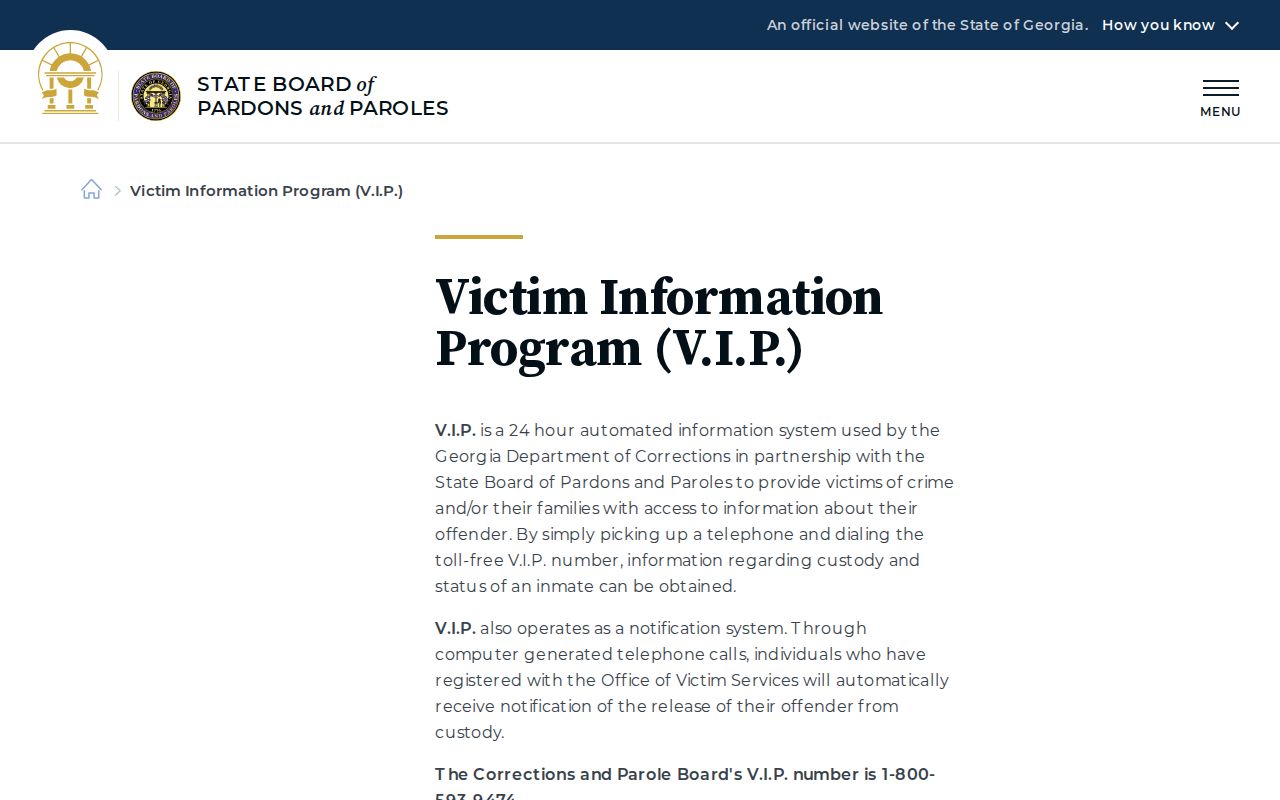
Together, the two services give online and phone options, but each still depends on the agency data supplied to it.
Greene County VINE Name Mismatches
A no-result screen can reflect spelling, not custody. Search a full legal name first, then test a documented middle name, prior surname, or identifying number. Do not broaden the search so far that a different person becomes a likely match. Date of birth, agency, and location should agree before an alert is attached.
Recent county-to-state transfers can create a gap. Greene County may have closed its jail record before GDC finishes intake and diagnostic processing. Search the sheriff record for the receiving agency, then check GDC again with the case number or GDC ID. VINE should not be used to fill that gap with a guess.
Greene County Release Alert Events
An alert may concern release, transfer, or another custody change. Those events are not interchangeable. A transfer means the person moved between custodians. A county discharge to GDC closes local custody but begins state custody. A release notice may still lead to parole or probation supervision.
Save the event wording, date, source agency, and person identifier when a notice arrives. Then contact that agency for the legal record. Greene County's sheriff record can show the discharge day, the order used, and the issuing court. A state record may show status and release-related dates. Neither record should be replaced by an alert message.
Greene County VINE Privacy Choices
Use contact details that can receive the chosen alert method and review each entry before submission. A mistyped phone number or email can prevent notice. Phone registration may use a PIN to acknowledge calls or manage the registration. Keep that PIN separate from public case notes.
Notification is optional. A person can search a record without assuming every available alert must be enabled. If safety or court obligations require dependable notice, use both the automated channel and direct agency confirmation. Technical delivery, feed timing, and agency participation can change.
Greene County Release Record Follow-Up
After VINE reports release, ask what record will explain it. For a Greene County jail event, O.C.G.A. 42-4-7 requires a sheriff's record with the discharge day, discharge order, and court that issued the order. Those facts can distinguish bond, sentence completion, dismissal, transfer, and another ordered exit.
The court record adds context. Greene County Magistrate Court handles early bond and preliminary matters. The Superior Court Clerk holds felony disposition and sentencing records. A VINE notice cannot tell whether the criminal case remains open or whether probation follows release.
For state custody, use GDC Find an Offender and written verification. The Board's Parolee Database applies after parole release, while DCS supplies the field-office route. A person residing in Greene County is served through the Milledgeville office. If a federal or ICE transfer is suspected, move to the separate federal locator instead of waiting for another Georgia VINE update.
Greene County VINE Check Timeline
A careful status check records what appeared and when. Note the person's displayed name, identifier, agency, facility, custody wording, and date. If an alert later arrives, compare it with the saved details before assuming it concerns the same event.
Next, contact the record holder. The sheriff can confirm a Greene County discharge. GDC can confirm state status. The Board and DCS address parole and supervision. BOP or ICE applies only when those custodians are involved. This sequence turns an automated notice into a verified timeline.
Do not keep searching the live roster after a confirmed release. A released person normally drops from a current-custody view. Move to the discharge record and court disposition, which outlast the jail stay and explain the authority for release.
Georgia VINE lists a statewide phone route at 1-833-216-6670. The separate Board and GDC V.I.P. system lists 1-800-593-9474. Record which line supplied an answer because the two services have different coverage. When a call reports “not in custody,” ask whether the statement concerns GDC, a participating local agency, or the specific record searched. Then confirm the release date and destination with the custodian. A telephone result has the same core limit as an online result: it reports supplied status but does not create the discharge order.